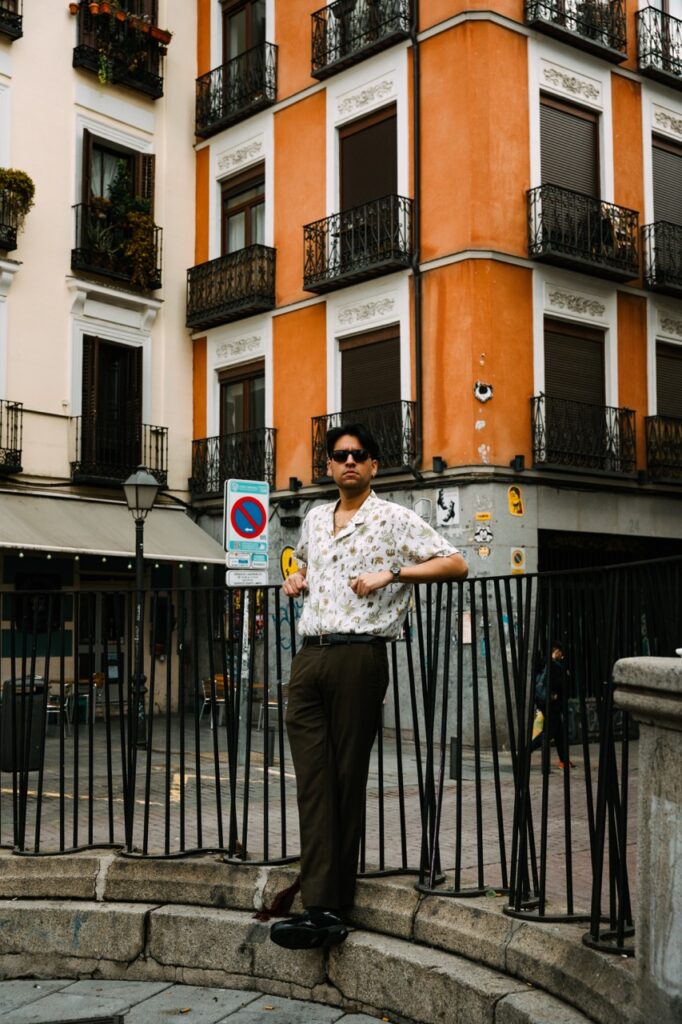
Based in Madrid and fronted by two lifelong best friends from Peru, Lima Shakes is a rock band navigating a busy year filled with major milestones. Writing original music in English within a local circuit heavily crowded by Spanish tribute acts, the trio brings a distinct, uncompromising voice to the independent scene.
In this interview, they share their perspectives on the realities of their local music industry, the mechanics of their creative process, and what it truly takes to build something authentic from the ground up.
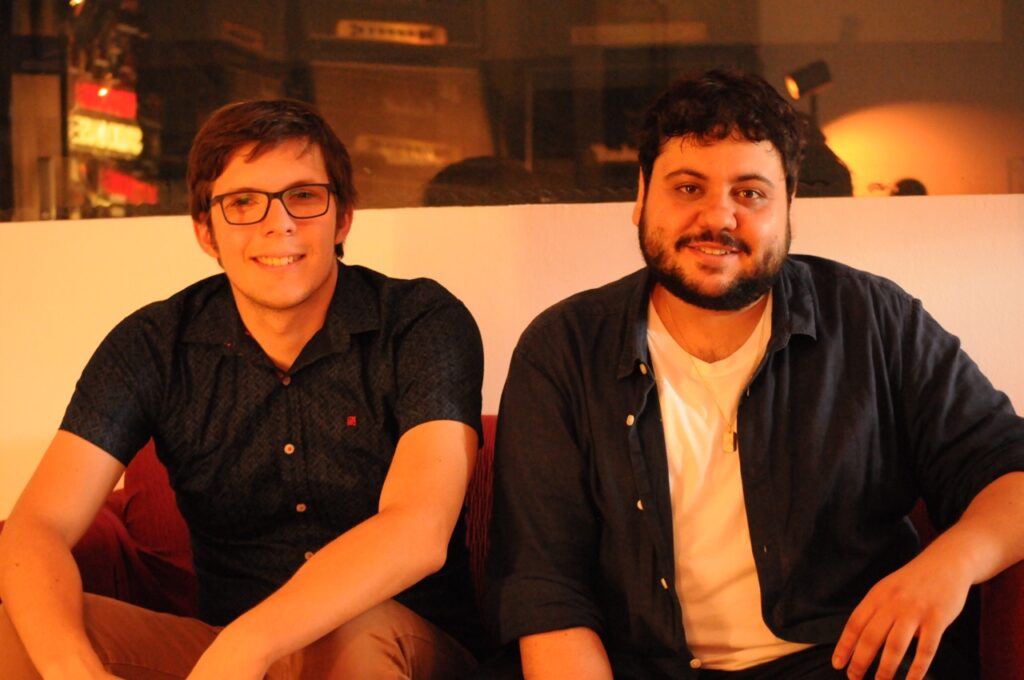
Q: What can you tell me about the process behind Around Tonight, the single that you released last month?
Alessandro: I wrote that song in 2023 or 2024, while I was still living in my old apartment. It brought me back to songwriting because I hadn’t done it in a while. The lyrics are basically about the beginning of my relationship with my girlfriend.
The song has evolved over the years. We made the arrangements while rehearsing, especially the rhythm section. We started playing it with our previous drummer, and now we have a supporting drummer who isn’t really part of the band, but is helping out a lot; and he’s also adapted it to his playing style.
We had the idea to release an album this year, before I turned 30, but it got a bit delayed because of some opportunities we took and how long the actual process takes. We’ve already recorded the rhythm sections for eleven songs over a ten-hour recording session. Some of them will make it to the album; others might not.
The plan for this song was to co-produce it with our current drummer. He mixed it, but we haven’t quite found the exact sound we want for the band yet. So, we decided to release it as a single—as a preview of what the album is going to be about—though we might get it remixed in the future, or even re-record it.
It’s part of an experimental process to see if a live recording style suits us, keeping it as natural as possible. For some things, it worked really well; for others, it needs some adjustments. For the album, which we expect to release next year, we’ll iron out the production and mixing details.
We recorded bass, drums, and the rhythm guitar simultaneously. Additional guitars were layered over that afterward, while keeping the core essence of what we had at the beginning.
Q: This year, Lima Shakes has played some major concerts like opening for The Kooks, the Sofar Sounds pop-up, and your first sold-out show at the Hard Rock Hotel in Madrid. Do you feel like all of these new opportunities are changing your vision for the future of the band?
Alessandro: I think we already had a pretty clear vision of what we wanted, but working on the album and seeing how much we’ve grown helped us realize that we shouldn’t rush things—we need to let them come at the right time without losing our essence. We’re maturing as well, and we prefer to do things the right way rather than rushing.
We used to think we had to meet certain rigid requirements to achieve our goals, but this year proved us wrong.
The year started off right for us. We recorded an acoustic live session at Comeback Studios and that well-produced session really opened some doors. Before that, we only had some pretty low-quality live videos and the music video for our first single, but that acoustic session was the true kick-starter of our year.
After releasing the single last month, we played the show at the Hard Rock. At first, we thought the venue was going to be too big to fill with our audience, but so many people reached out trying to get tickets that it was literally impossible to fit anyone else inside.
Alonso: I play in Madrid very often across different musical circles, and this year, my colleagues from other bands started paying attention to Lima Shakes, telling me how cool some of the things we’re doing are—talking about the concerts and recordings. People I play cumbia, neo-soul, or jazz with, and even people I’ve met at jams, have brought it up.
People are already recognizing us: Alonso, the bassist of Lima Shakes, and Alessandro, the frontman. Even if it’s only a little recognition, it’s there.
Alessandro: Yeah, I’ve been walking down the street with friends and had random people come up and ask, “Aren’t you the singer from Lima Shakes?”
Alonso: While Alessandro was studying for his master’s, his classmates were also well aware of the band because they met us at an event. They got to know us as individuals as well as members of Lima Shakes. We’re really building our identity.
Q: How accessible is Madrid’s music scene for a new band trying to establish itself?
Alessandro: I don’t think it’s especially easy or difficult. There are venues willing to let you play if you want to put on a concert, but the conditions are pretty rough, so it really depends on how practical it is for your specific situation. There are also plenty of jams and open mics where you can meet other musicians, make friends, and get invited to take part in their events. That said, trying to make money from live shows is pretty difficult at the beginning.
Alonso: There’s a clear dominance of the tribute-band market in Spain. It makes sense—people want to hear familiar music in Spanish.
I’ve played in several tribute bands over the years, and it’s striking how in big cities like Madrid, as well as in tiny towns, people want to hear the exact same songs they were listening to fifteen, twenty, or twenty-five years ago. For new bands—regardless of whether they sing in Spanish or another language—unless you’re covering Spanish classics, you’re in for a rough start.
Alessandro: I’ve also noticed that nowadays, most live-music venues view bands and musicians as clients rather than as an attraction.
Alonso: Exactly. Venues aren’t taking any risks at all anymore. The bands or musicians have to pay them, and it doesn’t matter to the venue whether you actually bring a crowd or just your five friends and three family members. They just don’t care.
That happens a lot at jam sessions, too, with very few exceptions for the tourist-oriented ones. It’s the musicians themselves who end up spending their money there, and I’m certainly not innocent of participating in that vicious cycle either.
Q: Which bands, domestic or international, would you most like to share the stage with?
Alessandro: I have two English bands in mind. One of them is The Molotovs—two siblings in their twenties who play Britpop.
The other is a dude named Laurie Wright. I think he has similar vibes to ours. He might be around the same age as us, but most importantly, he has that rock-and-roll essence that doesn’t give a fuck about being commercially acceptable; he just makes music that connects.
Alonso: The one I have in mind is a bit more utopian. I really like Nickelback, the Canadian band—they’re just great. I’m waiting for them to come to Spain.
Their hard-rock, grungy sound mixed with top-level ballads and pop songs is very cool. They’re a band that sounds awesome on stage and can make a stadium rumble with their music and performance. I love them, and I don’t think we’re that distant musically speaking, though, well, we’re generations apart.
Q: Being an independent band means handling a lot more than just the music. What does your workflow look like behind the scenes?
Alessandro: It all starts with the songwriting. I wrote a lot of the material starting when I was around nineteen. We’ve been playing, practicing, and rearranging those songs for years—live, in the studio, and at rehearsals. Newer songs, like Around Tonight, were written by me first; then Alonso and the drummers played them their own way.
So, the tracks are initially written by me, but we’ve played them so many times and in so many different ways that we end up choosing what works best. For specific situations, we actually get together to write the harmonies and additional arrangements.
Alonso and I split the management tasks.
Alonso: Yeah, we try to divide the labor. Usually, one of us takes the lead on a task and the other helps out if needed. One might call the studio to reserve a rehearsal space while the other sets up an interview. One might go pick up the rental drums while the other grabs the cymbals if they’re coming from different providers.
Each of us has our own life and day job, so we’re pretty flexible with rehearsals, trying to work them around our other commitments.
Alessandro: I think our current drummer has really helped us get better organized—planning weekly rehearsals or stepping them up when we have a specific show or recording session coming up. Before that, sometimes we would only rehearse for major gigs and then not touch it for a while.
Alonso: He also brought in some very interesting visual planners and charts to help us map out deadlines, strategies, and goals—along with things not directly related to the music, like social media management.
To be honest, I feel pretty lazy about doing those kinds of things. I’d love to have a label or management team handle all of that and just leave the songwriting, composition, and performance to us. But we’re an independent band, so that’s just part of what we have to deal with.
Alessandro: There’s also a Peruvian journalist named Paul Monzón who liked our music and has shown an interest in helping us as much as he can. He shares our music with some of his colleagues, and if they like it, they end up writing about us. That’s exactly how we ended up opening for The Kooks at Noches del Botánico.
Q: Do you feel like singing in English while based in Spain is more of an advantage or a hurdle for the band?
Alessandro: A little bit of both. The lyrics are in English because I write them, and I feel like I have more freedom in that language. I find it awkward when I try to write in Spanish. I started getting into music because when I was a kid I was struggling with English at school, and my dad offered to pay me three Soles (approximately $1.20 CAD) for every Beatles song I translated correctly. I’m not an idiot, so I translated them all and became a fan of The Beatles. That’s definitely part of it.
It’s also out of sheer defiance. Everybody used to tell me I had to write in Spanish, but the songs are mine and I’ll write them in English if I want to.
In Spain, singing in English makes it harder to integrate into the local circuit, but at the same time, that’s one of the things that sets us apart. Madrid is a city full of people who come from everywhere—exchange students, people relocated for work—and English is often the only common language.
It would be easier to sing in Spanish if our target audience were native Spanish speakers, but we have our own audience, and it works.
Alonso: I really like Spanish music; it’s part of my musical background. But I’m completely fed up with Spanish tribute bands saturating and monopolizing the market.
All the bands playing at local festivities are Spanish tribute acts, and yet we have the guts to stand up there playing original music in English in a market dominated by bands singing in Spanish. I think it’s quite a statement.
Alessandro: We used to play at a pretty small yet popular local venue where people would wander in around 3:00 AM, completely drunk, and ask us to play very specific popular Spanish songs. That’s actually when we ended up officially naming the band Lima Shakes and started presenting ourselves as such. We’re very grateful to live here—we really like it—but we aren’t from here. And just to mess with them, we started playing Spanish-language covers, but exclusively by South American bands—not a single one from Spain was allowed.
Q: You two have been friends forever. Do you feel like that lifelong friendship has been more of a positive or negative force in shaping the band?
Alonso: It reinforces how much we believe this is going to work out and benefit both of us equally. What I mean is that when you work with someone who isn’t your lifelong friend—maybe just an acquaintance—you have that underlying feeling that if something goes wrong with the band, it’s not really a big deal; everyone can just move on with their lives. But with Ale, we’ve been through thick and thin together.
We’ve studied together since primary school all the way through university. Ale got very sick and nearly passed away from COVID, and to me, the fact that he overcame that and the complications that came with it is proof that there’s something else out there for us to achieve. I don’t know exactly what it is, but we have to keep working toward it.
What I will always ensure while playing in a band with him—and I know he feels the same way—is that both of us are happy with what we’re doing and pulling in the same direction. We have complete trust that neither of us would ever try to take advantage of the other financially or in any other way. Pursuing individual interests at the other’s expense is completely off the table because of our decades-long friendship.
On top of that, we have a ton of fun handling band management tasks together. It brings us right back to when we used to hang out at his parents’ house in Peru or their beach house. That’s just how I feel about it.
Alessandro: I feel that our friendship brings nothing but good things to the band. Even though we have very different musical backgrounds, the chemistry we share on stage is remarkable.
Alonso understands me perfectly on stage; when we want to change or rearrange something, it happens in a snap. He gets it and adapts immediately, and everything flows naturally.
I think having a band with your best friend gives you the absolute confidence to say that this is going to work out. We don’t know exactly when, but it will. We’re happy to share this dream together, and we hope to eventually enjoy the fruits of our hard work. We enjoy the process, too—which also means eating a lot of crap together.
Alonso: I’m also involved with other bands where I have great bandmates that I’ve known for a little over a year, and I want to see those projects succeed, too. I play other genres with them that I love, and they help support me financially. But if any of those bands were to dissolve tomorrow, I certainly wouldn’t be losing sleep over what my ex-bandmates are doing—that’s for them to figure out.
I run Lima Shakes with my best friend, my mega-bro. If it ever ended, I’d be genuinely worried about Ale’s well-being. More than anything, I’d love for this band to succeed in a way that allows everyone involved to live with dignity, doing what we love without having to stress at the end of the month about how we’re going to pay our bills. And honestly, I feel like that’s a huge problem for our entire generation.
Q: Do you feel like this current recording and production process is throwing any new challenges your way?
Alessandro: I think the hardest part is listening to the recordings afterward and thinking you could have done something better, or feeling like it doesn’t quite represent what you want.
Sometimes you’re left with the thought that you could’ve performed at a higher level, but studio time isn’t unlimited. You’re always wondering if what you just did is the best you could possibly do, or if you’re just being limited by your resources.
You accept those facts because you want to meet your deadlines and release new music, but that’s also why we’re rethinking what to do with the album. We like some of the things we just recorded, but others still need improvement. We’ll keep all the original recordings as demos, but the album will definitely feature polished versions.
I feel like these songs deserve a lot of love. They’re great, and the whole concept of the album is about the transition from teenage years into adulthood in a non-linear way, complete with all the emotional ups and downs that come with it. The whole idea feels solid, and we want our first album to sound completely like us.
If we need to redo or re-record things for the sake of quality, we will. We aren’t in a hurry to release the album “as is” just because it’s what we can achieve right now. That’s fine for the singles, but the album has to reflect who we are and all the work we’re putting into it.
Alonso: I want the album to sound impactful—not generic at all. I want people who aren’t even musicians to appreciate the quality and say “wow!” the first time they hear it. Listeners don’t care about technical specs or the gear settings you use, but they can tell if it sounds powerful and hooks them right away. I want it to set the bar really high for what people expect from us once it drops.
Alessandro: The most important thing is that the songs should make you feel something. Our previous releases sound technically correct, but I don’t really feel moved by them. By contrast, they sound incredible when we play them live. It’s our job now to translate that same raw emotion into the recordings.
Alonso: In my opinion, this year we’re definitely getting closer to that.
Alessandro: Yeah. And beyond our own opinions, whenever I talk to someone who isn’t a close friend but has listened to our previous releases, they like them enough to come to a show. But after seeing us live, they walk away with a completely different impression—in a really positive way. It’s an entirely different experience. Why can’t we capture that same level of intensity in the recordings?
Alonso: Well, I’d honestly be more worried if it were the other way around—like if we had amazing studio production but couldn’t keep up on stage. So, I’m really happy with where we’re at in that regard. We just have to keep working on the recordings, and I know we’ll eventually reach our goal.
Q: You two are the core of Lima Shakes, but you’ve always played as a trio. How open or attached do you feel to that format?
Alessandro: We’ve added extra instruments to the recordings, like additional guitars or keyboards; and though they benefit the recorded versions, you don’t really miss them when we play live. They aren’t required for what we want to portray on stage.
Alonso: We actually had an additional guitar player for the Noches del Botánico concert—he was the lead guitarist, playing solos and other lines. We’ve never been four on stage except for that night.
Alessandro: It was fine, but I feel like we reach our desired level of impact much more easily when there are just three of us. That comes down to the chemistry Alonso and I share on stage. If we add someone else who doesn’t quite get it, they won’t improve the result. As for the drummer, we need one and are lucky enough to have one right now whom we’ve known for a very long time—someone who understands us and adapts easily.
Alonso: Yeah. And once again, compared to the tribute bands I’ve played with, they just need people to learn the parts and play them perfectly. But when you’re working on a personal project with its own identity and concept, it’s a whole different game. It’s not just about replaying notes flawlessly; it’s about making a real, authentic impact.
Alessandro: Another perk of playing just with Alonso is that since we play the only instruments carrying the harmony and melody, if I feel like I might not hit certain high notes on a given day, Alonso’s perfect pitch allows him to transpose without hesitation.
Alonso: We do it with zero issue and without having to explain a thing to anyone. We change the key in situ and it works seamlessly. It just comes from years of experience. We also shift the tempo sometimes, knowing for absolute certain everyone will follow right along. I also know how Ale shifts his phrasing when he feels it, and I just follow his lead. Some musicians play without listening or paying attention to the people around them, but we are in constant communication.
Alessandro: That’s the chemistry we’ve been building since we were kids. We started the band here in Spain, but we’ve been playing together since we were ten. We know how to interact on stage without even speaking—just catching each other’s eye is enough to know what’s going on.
Alonso: Having perfect pitch also means I’m always tracking the notes, and it’s amazing how effortlessly Ale can switch keys. That doesn’t happen very often with singers. I say that first as a compliment, and second as a matter of experience, because I work with other vocalists who find it much more difficult.
I don’t mean to criticize anyone—everyone has their own strengths—but the ease with which Ale switches keys or alters melodic lines is quite remarkable.
At some point, since I’m also a keyboardist and actually have far more years of experience on keys than on bass, I’d love to play some keyboard parts. But I don’t have four arms, and these days I’ve realized I prefer playing the bass. Still, it would be great to have a keyboardist join us one day to handle organ or Hammond stuff—Deep Purple or Boston style.
An immediate perk of being a three-piece is simply logistics. It’s a matter of numbers: the fewer people you have, the easier it is to get together.
Q: Have you ever thought about the reasons why you make music?
Alessandro: It’s not explicitly in the songs, but to me, making music is a form of freedom. It’s a place where I can make decisions without explaining them to anybody and just be myself. I just want to offer something organic.
In the past, because of my own insecurities, I thought my music had to be to other people’s liking or aligned with commercial standards. But nowadays, I just want to listen to something made by me and get excited about it. That’s enough for me now. And if it can also move someone else’s emotions, that would be great.
That would be our little contribution to humanity—as small as it is—but moving someone’s feelings is already a lot to me.
Alonso: To me, music has always been a way to exteriorize my inner self; to portray whatever I have inside, whether it’s happiness, anxiety, the desire to create, or any other sort of energy that’s built up inside and won’t come out for some reason.
It’s also my emotional language—a way to communicate with other people in a medium I feel entirely comfortable with.
Plus, listening to music, whether live or through headphones, fills me with a kind of energy I just don’t get from any other activity.
I can go swimming, play sports, or dance (even though I’m a terrible dancer), but going to a concert, hitting a jam session, or listening to music on my headphones takes me to a different world where I don’t think about my job or being far from home. I don’t think about anything except what the music makes me feel. Nothing else can give me that.
It’s not about escaping a reality I don’t want to face. It just makes me happy and free without making me feel like I need to hide or fix anything. That’s a whole different context.
Featured post photo by Tatiana Blanco for Sofar Sounds Madrid
Post photo by Lucía Puig
Interview by Wi-Sin Llajaruna
You can follow Lima Shakes on Instagram (@limashakes) and stream their music using the player below.