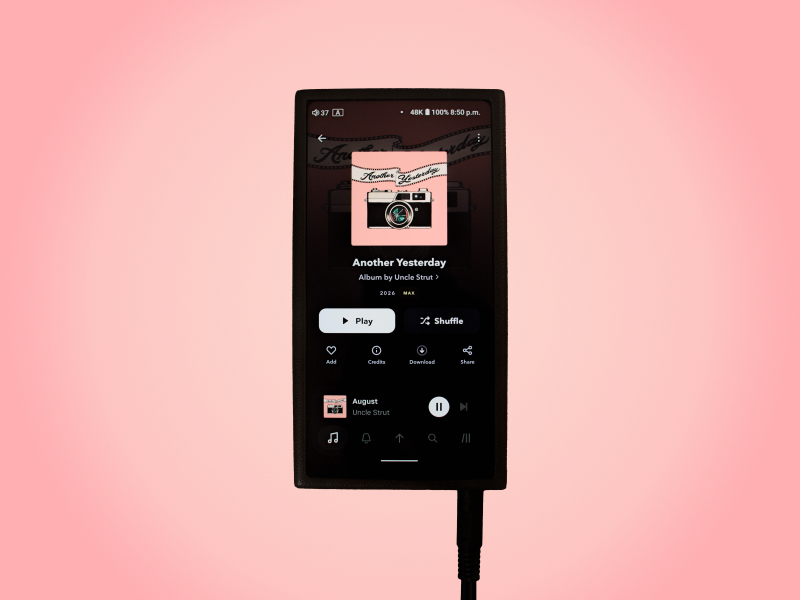
Released: October October 23, 2026
Genre: Alternative-Rock
I have never been too interested in listening to EPs; Not because I have anything against them, and even less because of the music itself. It’s just because I prefer longer stories and the emotional rollercoasters that LPs usually offer.
That being said, I usually and unintentionally limit my EP listening time to either discovering new bands or supporting a friend’s latest release; and the fact that I’m reviewing this one already says a lot.
Initially, I approached this EP as a way to discover Uncle Strut, the Vancouver-based Canadian band and self-proclaimed ambassadors of “Canadian Croc Rock” (there is little to no information about what the heck that is, so go Google it). It resulted in a very pleasant surprise when I found out that within such a short duration, they manage to tell a well-developed story.
The lyrics make the storyline quite clear. In the opening track, Another Yesterday, the narrator talks in the first person about a couple trapped in a routine while hiding struggles that seem to have been part of their relationship from the very beginning. As the title track, it instantly sets the tone for the EP.
In the second song, Ain’t Coming Back, the narrator assumes the role of both the angel and the devil on the main character’s shoulders. It starts by telling him that his appearance, perception of reality, and ideas reflect his current mental state and that he desperately needs a change. Later, in the chorus, we find out that this change involves leaving everything behind to escape; the second verse confirms that he actually left.
In Bitter Ends, the third song, our protagonist describes an intimate encounter he knows won’t end well. He explains that it’s a repetitive, confusing cycle that he finds difficult to break.
The fourth track, Call My Name, acts as a love letter where he paints a picture of what life could be like if they got back together. He feels crazy about her and knows she feels the same, yet she fights the impulse of returning to him.
Finally, in August, he speaks to his ex-partner (yes, at this point there is more than enough evidence to call her that) about their past good times, wishing he could freeze that moment so she remains a permanent part of his life rather than just a closed chapter.
Musically, this EP leaves no room for guessing how the narrator feels. In Another Yesterday, the laid-back instrumentation pairs with the lyrics to create an atmosphere akin to defeat. Ain’t Coming Back features a more upbeat rhythm that makes the narrator sound cocky. Bitter Ends leans into a danceable rhythm reminiscent of reggaeton and Afro-Caribbean styles; both things are historically tied to mating rituals, which fittingly mirrors the intimacy described in the lyrics.
In Call My Name, the main vocal melodies have very little movement, typically resolving in a downward direction (musically associated with rest). Yet phrases like “when you call my name” and “it drives me insane” feature ascending melodies and are practically yelled, signaling the opposite: restlessness and desperation. That subtle melodic restraint captures the exact middle point between those two conflicting feelings, showing that our main character is growing increasingly frantic because he knows that she knows that he knows (hopefully that’s clear enough, because that’s literally what the lyrics say). Lastly, August is the EP’s ballad. Ballads are the music of romance and heartbreak; its three-quarter time signature, traditionally tied to dancing and mating territory and that in recent years adopted a dramatic, nostalgic connotation; rounds it out perfectly.
With this EP, Uncle Strut has nailed every detail. The lyrics and the music serve the exact same purpose, and it’s executed brilliantly. The production does precisely what it’s supposed to do: it elevates the intention behind the music. The tracks never sound monotonous, and the EP as a whole tells a complete story without any missing pieces. It might be stating the obvious, but as an EP, nothing here feels superfluous.
Reviewed by Wi-Sin Llajaruna